
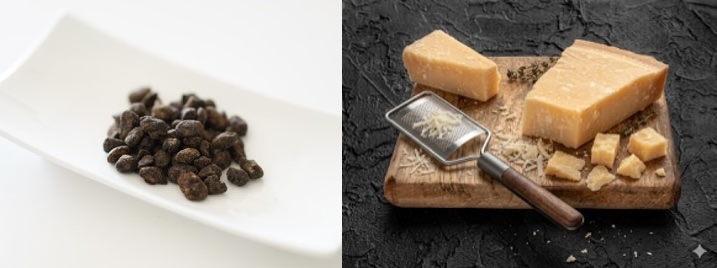
Hamanatto vs Parmesan Cheese
What’s the Difference?
Hamanatto vs Parmesan Cheese
When chefs talk about ingredients that naturally deliver deep umami, Parmesan cheese is almost always part of the conversation.
Its rich, nutty flavor has made it one of the world’s most respected aged foods.
Surprisingly, another ingredient can create a similar impression—even though it comes from a completely different culinary tradition.
That ingredient is Hamanatto.
One is made from milk.
The other is made from soybeans.
One represents centuries of Italian cheesemaking.
The other reflects one of Japan’s oldest fermentation traditions.
Although they appear completely unrelated, both develop remarkable umami through long periods of aging.
This shared characteristic has led many chefs to compare them as natural flavor enhancers.
The similarities, however, end there.
Hamanatto and Parmesan differ in ingredients, texture, fermentation, and how they are used in the kitchen.
Quick Comparison
| Feature | Hamanatto | Parmesan Cheese |
|---|---|---|
| Country of Origin | Japan | Italy |
| Main Ingredient | Soybeans | Cow’s milk |
| Texture | Firm and chewy | Hard and crumbly |
| Aging | About one year or longer | Usually 12–36 months |
| Main Use | Finishing ingredient & cooking seasoning | Grated seasoning or table cheese |
| Flavor | Deep fermented umami | Nutty, savory umami |
What Is Parmesan Cheese?
Parmesan, or Parmigiano Reggiano, is one of Italy’s most famous cheeses.
It is produced from cow’s milk and aged for at least 12 months, with many premium wheels maturing for 24 to 36 months.
During aging, moisture gradually evaporates while proteins break down into flavorful compounds that create its distinctive savory taste.
Parmesan is commonly enjoyed:
- Grated over pasta
- Added to risotto
- Shaved onto salads
- Served with wine
- Enjoyed as a table cheese
Its natural umami is one reason it has become an essential ingredient in professional kitchens around the world.
What Is Hamanatto?
Hamanatto is one of Japan’s oldest fermented soybean foods.
Whole soybeans are fermented with koji mold before being carefully aged for more than one year.
As moisture slowly decreases, the beans develop increasingly concentrated umami while remaining firm and intact.
Unlike Parmesan, Hamanatto is not grated or melted.
Each soybean delivers its own burst of flavor, making texture just as important as taste.
Its rarity and traditional production have made it a prized ingredient among chefs interested in authentic Japanese fermentation.
Why Are They Often Compared?
At first, comparing Hamanatto with Parmesan may seem unusual.
One is a fermented soybean.
The other is an aged cheese.
Yet chefs frequently mention them together because both are outstanding examples of naturally developed umami.
Neither relies on artificial flavor enhancers.
Instead, time, microorganisms, and careful craftsmanship gradually create their rich, complex flavors.
For this reason, both ingredients are often used sparingly.
A small amount can transform an entire dish.
Discover Authentic Japanese Umami
Both Hamanatto and Parmesan demonstrate how patience creates extraordinary flavor.
Experience authentic Hamanatto and discover how traditional Japanese fermentation transforms simple soybeans into one of the world’s most distinctive natural umami ingredients.
Texture: Firm Soybeans vs Hard Cheese
One of the biggest differences between Hamanatto and Parmesan becomes clear the moment you take your first bite.
Hamanatto consists of whole fermented soybeans.
Each bean remains intact after more than a year of aging, creating a pleasantly firm and chewy texture. As you chew, the beans gradually soften and release increasingly complex layers of umami.
Parmesan is also firm, but in a completely different way.
Aged Parmigiano Reggiano is hard, dry, and slightly crumbly. Rather than chewing individual pieces, it breaks into delicate crystals that melt slowly in the mouth.
Both ingredients reward slow eating, but they create very different sensory experiences.
Flavor: Earthy vs Nutty
Although both are famous for their natural umami, their flavor profiles are remarkably different.
Hamanatto offers deep fermented notes with hints of:
- Roasted soybeans
- Dark miso
- Cocoa
- Toasted nuts
- Aged fermented soy
Its flavor develops gradually, becoming richer with every bite.
Parmesan is known for its:
- Nutty richness
- Buttery character
- Savory saltiness
- Slight sweetness
- Long-lasting umami
Instead of competing with one another, these ingredients represent two different expressions of naturally developed umami.
Aroma: Fermented Soybeans vs Aged Milk
The aromas reveal the greatest difference between the two foods.
Hamanatto develops a mature fragrance during its long fermentation.
Depending on its age, you may notice aromas similar to:
- Soy sauce
- Roasted soybeans
- Toasted nuts
- Cocoa
- Long-aged fermented foods
Parmesan develops its aroma through the slow aging of milk.
Its fragrance is often described as:
- Nutty
- Buttery
- Fruity
- Warm
- Richly savory
Both aromas are unmistakable, yet they reflect completely different fermentation traditions.
The Aging Process
Time is the secret behind both ingredients.
Hamanatto is fermented with koji mold before being carefully aged for approximately one year or longer.
Throughout this period, microorganisms slowly transform soybean proteins into flavorful compounds that create its concentrated umami.
Parmesan follows a different path.
After cheesemaking, each wheel matures for at least 12 months, while premium Parmigiano Reggiano is commonly aged 24 to 36 months.
During aging, moisture gradually evaporates and proteins break down naturally, producing the characteristic crystals and savory flavor that cheese lovers appreciate.
Although their ingredients differ completely, both foods demonstrate how patience creates exceptional taste.
How Professional Chefs Use Them
Chefs value both Hamanatto and Parmesan because even a small quantity can transform a dish.
Parmesan is commonly used for:
- Pasta
- Risotto
- Salads
- Soups
- Cheese boards
It melts into dishes and creates a smooth, savory richness.
Hamanatto is commonly used for:
- Steak
- Pasta
- Risotto
- Seafood
- Roasted vegetables
- Tofu
- Fine dining garnishes
Unlike Parmesan, Hamanatto remains visible on the plate, contributing texture as well as concentrated umami.
Many chefs appreciate this ability to create contrast while enhancing flavor.
Discover Authentic Japanese Umami
Parmesan has inspired chefs for centuries.
Hamanatto offers another expression of naturally aged umami—crafted from soybeans using traditional Japanese fermentation.
Discover how this rare ingredient can add remarkable depth to your cooking.
Can Hamanatto Replace Parmesan Cheese?
The answer is sometimes—but not completely.
Many chefs use Parmesan and Hamanatto for the same purpose: adding natural umami.
However, they contribute that umami in very different ways.
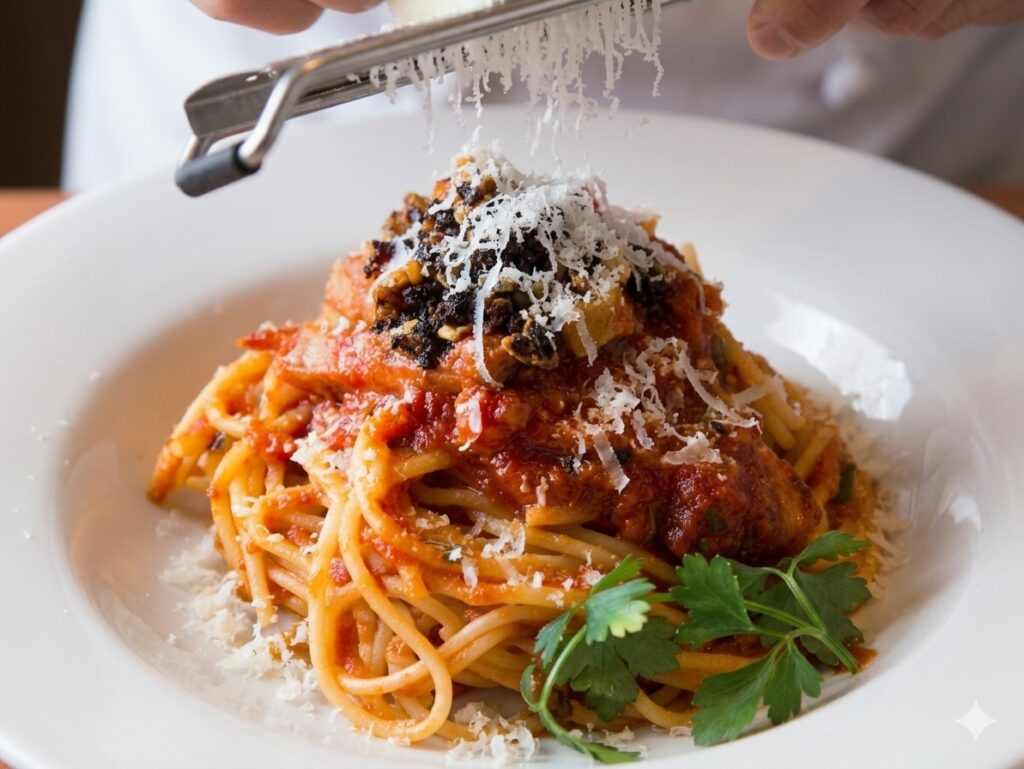
Parmesan melts into a dish.
When grated over hot pasta or risotto, it blends smoothly and creates a rich, creamy finish.
Hamanatto behaves differently.
Its firm soybeans remain intact even after being added to warm dishes.
Instead of disappearing, each bean delivers concentrated bursts of umami while adding an enjoyable chewy texture.
For this reason, Hamanatto should not be viewed as a substitute for Parmesan.
Instead, it offers chefs an entirely different way to build flavor.
Which One Should You Choose?
The best choice depends on the dish you are preparing.
Choose Parmesan if you want:
- A creamy finish
- A cheese-based umami
- A classic Italian flavor
- A grated topping that melts into food
Choose Hamanatto if you want:
- A plant-based source of umami
- A unique Japanese ingredient
- A firm texture as well as flavor
- A rare fermented delicacy
- A distinctive finishing ingredient for modern cuisine
Some chefs even combine both.
Grated Parmesan provides a rich background of savory flavor, while a small amount of chopped Hamanatto adds texture and an extra layer of mature umami.
Frequently Asked Questions
Does Hamanatto taste like Parmesan?
No.
Although both are naturally rich in umami, their flavors are quite different.
Parmesan is creamy, nutty, and dairy-based.
Hamanatto is deeper, earthier, and develops its complexity through soybean fermentation.
Is Hamanatto vegan?
Yes.
Traditional Hamanatto is made entirely from plant ingredients.
For chefs creating vegan dishes, it can provide natural umami without using dairy products.
Can Hamanatto replace Parmesan in pasta?
Not completely.
Parmesan contributes richness and creaminess as it melts.
Hamanatto contributes concentrated umami and texture.
Many chefs prefer using Hamanatto as a finishing ingredient rather than a direct replacement.
Which ingredient contains more umami?
Both are naturally rich in glutamates developed through aging.
Rather than measuring which is “stronger,” it is more accurate to say they express umami in different ways.
Parmesan offers smooth, rounded richness.
Hamanatto provides a cleaner, longer-lasting fermented umami.
Why do Michelin chefs find Hamanatto interesting?
Because it offers something few ingredients can provide.
It combines:
- Traditional Japanese craftsmanship
- Long-term natural fermentation
- Intense umami
- A distinctive chewy texture
These qualities allow chefs to create dishes that are both visually and gastronomically memorable.
Chef’s Verdict
For professional chefs, Hamanatto and Parmesan are not rivals.
They are complementary ingredients.
Parmesan remains one of the world’s finest aged cheeses and an essential part of Italian cuisine.
Hamanatto represents one of Japan’s oldest fermentation traditions, bringing a completely different expression of umami.
Understanding both allows chefs to expand their creative possibilities.
Instead of choosing one over the other, many modern kitchens use each where its strengths shine most.
Final Thoughts
Hamanatto and Parmesan demonstrate that great flavor often comes from the same principle:
Time.
Whether aging milk into cheese or fermenting soybeans for more than a year, patience transforms simple ingredients into extraordinary foods.
One belongs to the culinary heritage of Italy.
The other represents centuries of Japanese fermentation.
Together, they remind us that the world’s greatest ingredients often share a common goal—to create unforgettable umami.
Related Articles
Continue exploring naturally umami-rich ingredients:
- What Is Hamanatto?
- What Hamanatto Tastes Like
- How Hamanatto Is Made
- Hamanatto vs Natto
- Hamanatto vs Miso
- Hamanatto vs Soy Sauce
- Hamanatto vs Douchi
- Hamanatto vs Marmite
- Why Michelin Chefs Should Know Hamanatto
Discover Authentic Hamanatto
Parmesan has inspired chefs for centuries.
Hamanatto offers another path to extraordinary umami—crafted from soybeans, naturally fermented, and aged for more than one year.
Discover one of Japan’s rarest fermented delicacies and experience a new dimension of natural umami.