Why Hamanatto Has Such Deep Umami
The Science Behind Its Flavor
- Why Hamanatto Has Such Deep Umami
- The Starting Point: Soybean Protein
- What Microorganisms Do During Hamanatto Fermentation
- Enzymes Are the Hidden Workers
- From Protein to Free Amino Acids
- Why Fermentation Can Increase Umami
- Hamanatto Is Not Ordinary Natto
- Why Hamanatto Beans Stay Intact
- Salt Changes the Fermentation Environment
- Why Aging Matters
- Umami Is More Than Glutamate
- The Science Behind the Aroma
- Why Hamanatto Can Taste So Concentrated
- Why Hamanatto Tastes Different From Miso
- What Makes Hamanatto Scientifically Interesting?
- What We Can—and Cannot—Say About Hamanatto’s Umami
- A Chef’s Perspective: Why This Matters in the Kitchen
- My Take: Why the Flavor Feels So Deep
- Chef’s Verdict
- Try Authentic Hamanatto
- Continue Reading
- Final Thoughts
- References
Why Hamanatto Has Such Deep Umami
Hamanatto is often described as intensely savory, salty, and deeply fermented.
But what actually creates that flavor?
The answer is more interesting than simply saying that Hamanatto is “rich in umami.”
Hamanatto is a traditional fermented soybean food made through a process involving microorganisms, enzymes, salt, drying, and aging.
These processes gradually transform the soybean’s original proteins and other components, creating the distinctive taste, aroma, and texture of the finished product.
This also makes Hamanatto very different from ordinary sticky natto.
Although both foods are made from soybeans, they rely on different fermentation traditions and microorganisms.
Understanding this difference is important if we want to explain Hamanatto scientifically rather than simply calling it “old-fashioned natto.”
In this article, we will look at what happens to soybeans during Hamanatto fermentation and why the finished product can have such a concentrated savory character.
The Starting Point: Soybean Protein
The story begins with the soybean.
Soybeans are rich in protein, but intact proteins are large molecules. They do not simply behave in the same way as the free amino acids that contribute to the taste of many fermented foods.
During fermentation, microorganisms produce enzymes that act on components of the soybean.
One important group of enzymes is proteases.
Proteases break proteins into smaller peptides and, ultimately, free amino acids.
This process is known as proteolysis.
One amino acid that matters particularly to umami is glutamic acid.
When glutamate is present in its free form, it can contribute strongly to the human perception of umami.
This is one reason fermented soybean foods can develop a savory character that is very different from the flavor of freshly cooked soybeans.
However, it is important not to reduce Hamanatto’s flavor to glutamate alone.
Its final taste is influenced by many compounds and physical properties working together.
What Microorganisms Do During Hamanatto Fermentation
Microorganisms are central to the fermentation process.
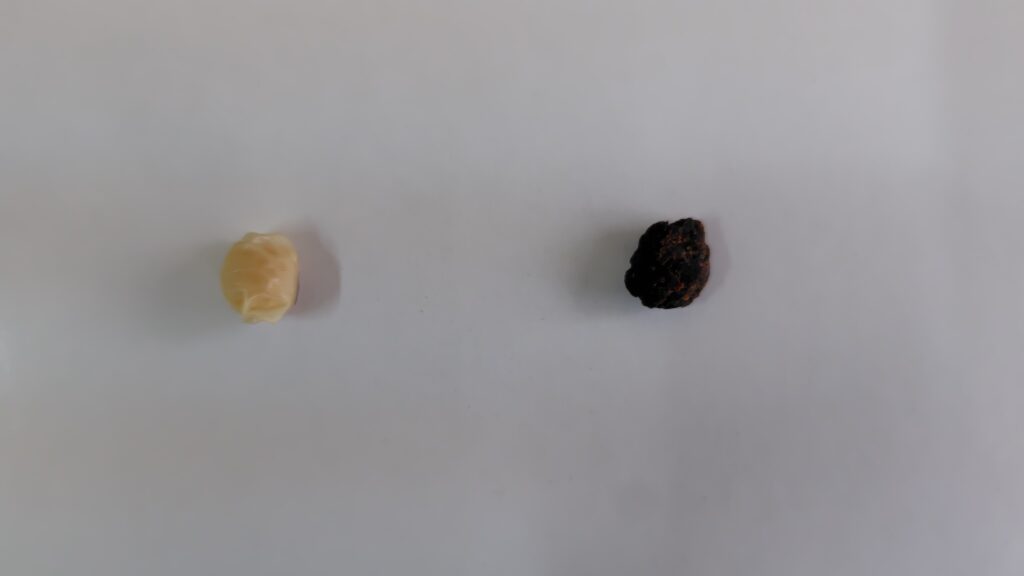
Historical microbiological research on Hamanatto identified several types of microorganisms associated with the food, including filamentous fungi resembling Aspergillus oryzae and lactic acid bacteria.
This is one of the clearest scientific reasons Hamanatto should not simply be treated as ordinary natto.
Different microorganisms produce different enzymes and metabolites.
Those enzymes and metabolites influence the chemical changes that take place during fermentation.
Research on Hamanatto found that some of the A. oryzae-type filamentous fungi isolated from the product showed strong protease and amylase activity.
That finding is particularly interesting from a food-science perspective.
Proteases can break down proteins, while amylases act on starch-related components.
The microorganisms therefore do not merely “sit” on the soybean.
They actively change its chemical composition.
Enzymes Are the Hidden Workers
The microorganisms themselves are only part of the story.
Their enzymes are the chemical workers that help transform the soybean.
A simplified way to visualize the process is:
Soybean proteins
↓
Peptides
↓
Free amino acids
↓
Changes in taste and aroma
This is not a single reaction occurring all at once.
It is a collection of biochemical processes taking place over time.
As proteins are broken down, smaller molecules become available.
Some contribute directly to taste.
Others can participate in further reactions that influence aroma and overall flavor.
This helps explain why fermentation can produce a food that tastes dramatically different from its original ingredients.

From Protein to Free Amino Acids
The transformation from protein to free amino acids is one of the most important concepts for understanding fermented soybean foods.
Soybean proteins contain many amino acids.
Fermentation can increase the amount of amino acids present in free form because microbial enzymes break down larger proteins and peptides.
Glutamate is one of the important amino acids associated with umami.
But this does not mean that every fermented soybean food develops the same flavor.
The amount and balance of amino acids depend on many factors, including the microorganisms involved, fermentation conditions, salt concentration, temperature, moisture, and length of fermentation.
This is why we should be careful when making simple statements such as “longer fermentation always means more umami.”
The science is more complicated—and more interesting—than that.
Why Fermentation Can Increase Umami
The basic principle is relatively simple.
Microorganisms produce enzymes.
Enzymes break down larger molecules.
Some of the resulting smaller molecules can contribute to taste.
In soybean fermentation, protein breakdown is particularly important because it can increase the availability of free amino acids.
The Umami Information Center describes a similar process in miso, where soybean proteins are broken down during fermentation and free amino acids, including glutamate, contribute to the finished food’s savory character.
Hamanatto is not miso, however.
The exact chemical composition of one Hamanatto product should not be assumed to be identical to that of miso or another fermented soybean food.
Instead, the scientific principle gives us a framework for understanding what is happening:
Fermentation changes the chemical form and balance of compounds already present in the soybean.
That transformation is one of the foundations of Hamanatto’s flavor.
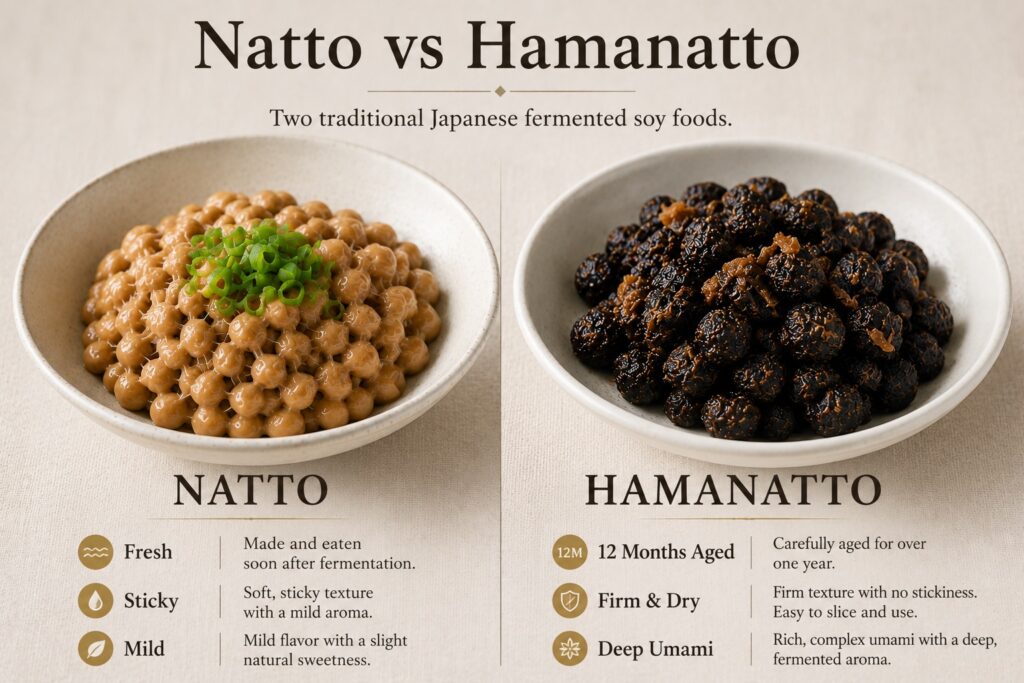
Hamanatto Is Not Ordinary Natto
This distinction deserves special attention.
Ordinary sticky natto is primarily associated with fermentation by Bacillus subtilis var. natto.
One of its most recognizable characteristics is the sticky, string-forming material surrounding the beans.
That material contains large amounts of poly-γ-glutamic acid, commonly called γ-PGA.
Hamanatto follows a different fermentation tradition.
Research on Hamanatto has identified filamentous fungi, including A. oryzae-type organisms, as microorganisms associated with its fermentation.
This difference helps explain why the two foods are so different in appearance and eating experience.
| Ordinary Natto | Hamanatto |
|---|---|
| Primarily associated with Bacillus subtilis var. natto | Associated with koji-related filamentous fungi and other microorganisms |
| Characteristically sticky | Firm and relatively non-sticky |
| Shorter fermentation process | Fermentation followed by salting, drying, and aging |
| Famous for its stringy texture | Known for its firm fermented beans |
| Fresh, distinctive natto aroma | Mature, concentrated fermented aroma |
The two foods share a raw material, but they should not be treated as the same fermentation process.
For anyone interested in Japanese fermented foods, this is an important distinction.
Why Hamanatto Beans Stay Intact
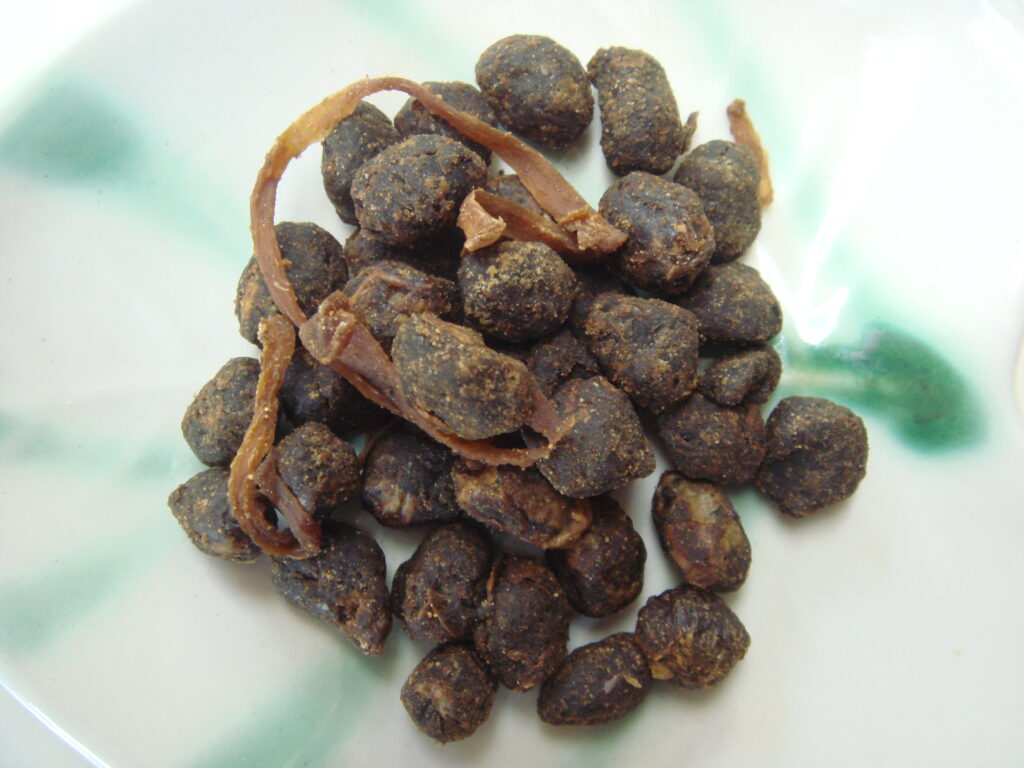
One of Hamanatto’s most fascinating characteristics is the appearance of the finished beans.
Even after fermentation and aging, the individual soybeans remain recognizable.
This is an important physical difference from fermented soybean foods that are transformed into a paste.
Traditional Hamanatto production involves carefully processing the beans while maintaining their overall form.
Drying, salting, and aging then contribute to the final texture.
The result is unusual from a food-science perspective:
A soybean can undergo substantial chemical transformation without becoming an entirely different physical form.
The bean remains recognizable, but its taste, aroma, moisture content, and texture change dramatically.
This is part of what makes Hamanatto interesting as an ingredient.
Salt Changes the Fermentation Environment
Salt has two important roles in Hamanatto.
First, it contributes directly to the food’s flavor.
Second, salt changes the environment in which microorganisms can grow.
Salt therefore becomes part of the fermentation system rather than simply being added at the end for seasoning.
This is particularly important because Hamanatto is not simply fermented and immediately eaten.
Traditional production involves fermentation followed by salting, drying, and aging.
As water is removed, the remaining components become more concentrated.
This helps create the intense sensory experience associated with the finished product.
Why Aging Matters
Time is another important part of Hamanatto’s character.
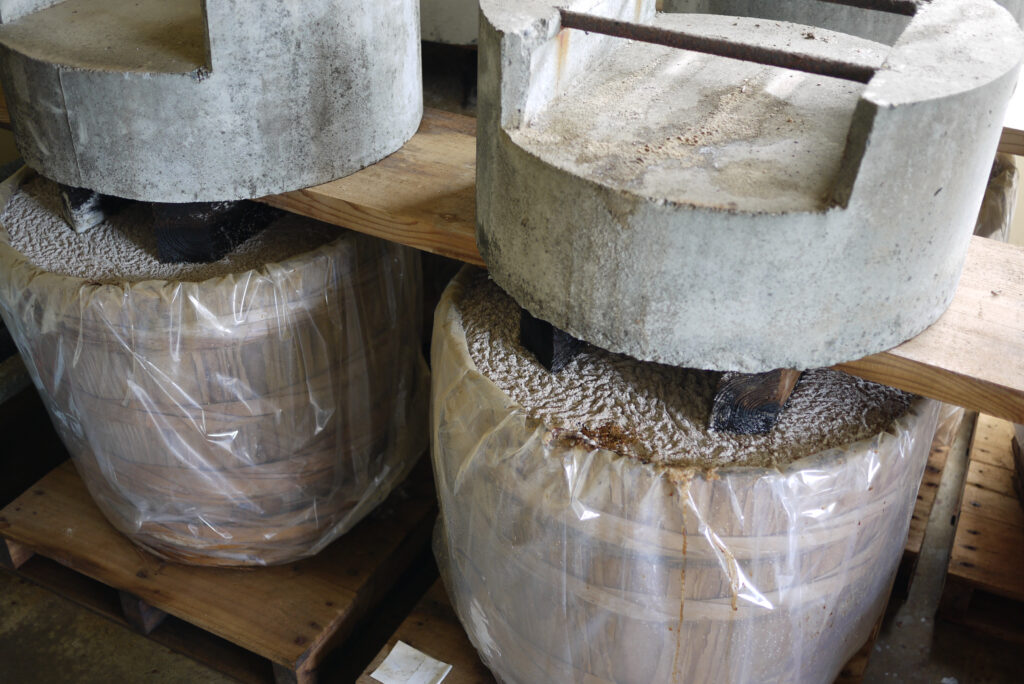
Traditional Hamanatto undergoes a comparatively long process of fermentation and aging.
During this period, chemical and microbial processes continue to change the food.
Proteins and peptides can continue to change.
Microbial metabolism can alter organic acids and other compounds.
Drying changes moisture content and texture.
And volatile compounds can contribute to changes in aroma.
But there is an important scientific caution.
It would be misleading to say that longer fermentation automatically produces more umami.
Fermentation is a biological process.
The result depends on the microorganisms, temperature, salt concentration, moisture, raw materials, oxygen conditions, and other factors.
In other words:
Time matters—but time alone does not determine flavor.
Umami Is More Than Glutamate
When people hear the word “umami,” they often think only of glutamate.
Glutamate is certainly important.
But the experience of umami is not simply a measurement of one molecule.
Taste-active compounds interact with one another, while aroma and texture also influence how we experience food.
This is especially important for fermented foods.
A fermented ingredient can contain glutamate alongside peptides, organic acids, salts, sugars, and volatile compounds.
These compounds can affect the overall sensory experience.
That is why two foods with similar amounts of a particular taste-active compound can still taste completely different.
Hamanatto’s character comes from the entire fermented food matrix rather than from one isolated molecule.
The Science Behind the Aroma
Taste is only one part of Hamanatto’s sensory character.
Aroma also plays a major role.
Fermentation changes the chemical environment of the soybean and can lead to the formation or transformation of volatile compounds.
These compounds reach the nose and contribute to the perception of fermented, roasted, mature, or savory aromas.
Research on fermented soybean foods such as natto has shown that volatile compounds can change during fermentation and post-ripening.
These findings should not be presented as direct chemical measurements of Hamanatto.
However, they illustrate a broader principle:
Fermentation can transform not only taste, but also aroma.
This helps explain why mature fermented foods can smell fundamentally different from their original ingredients.
Why Hamanatto Can Taste So Concentrated
There is also a physical reason Hamanatto can taste so intense.
Fresh soybeans contain a significant amount of water.
Hamanatto undergoes drying, which reduces its moisture content.
As water is removed, the remaining components become more concentrated.
The result is a small fermented bean carrying a dense combination of savory, salty, fermented, and aromatic characteristics.
This is one reason Hamanatto can function more like a seasoning than a conventional soybean dish.
A small quantity can influence the character of an entire dish.
It does not necessarily need to dominate the plate.
Instead, it can provide another layer of depth.
Why Hamanatto Tastes Different From Miso
Hamanatto and miso share an important biochemical principle.
Both involve microorganisms and enzymes transforming soybean components.
But the finished foods are physically very different.
Miso is generally produced as a paste.
Hamanatto retains recognizable soybean pieces.
Their production conditions, moisture levels, salt environments, and physical structures also differ.
The result is a different culinary experience.
Miso distributes its fermented flavor throughout a paste.
Hamanatto delivers a concentrated fermented bean that can be tasted, chewed, or used as a seasoning.
The comparison is useful because it shows that similar raw materials can produce very different foods when fermentation systems are different.
What Makes Hamanatto Scientifically Interesting?
Hamanatto is interesting because several food-science processes occur together.
1. Proteolysis
Enzymes break soybean proteins into smaller peptides and amino acids.
2. Microbial metabolism
Microorganisms transform components of the soybean and produce metabolites.
3. Salt-controlled fermentation
Salt changes the microbial environment and contributes directly to taste.
4. Drying
Water removal changes texture and concentrates the remaining components.
5. Aging
Chemical and microbial changes continue over time.
6. Aroma development
Fermentation and aging can change volatile compounds that contribute to aroma.
Together, these processes transform the soybean into a food with a completely different sensory profile.
The finished Hamanatto is therefore not simply “a soybean that has fermented.”
It is the result of a long chain of biological and chemical changes.
What We Can—and Cannot—Say About Hamanatto’s Umami
There is a temptation to make dramatic claims about Hamanatto.
For example:
“Hamanatto contains more glutamate than every other fermented food.”
Or:
“One year of fermentation automatically produces a specific amount of umami.”
We should be careful with claims like these.
Without standardized chemical analysis of the specific product, they cannot be treated as established facts.
What the available evidence does allow us to say is more precise.
Hamanatto is a fermented soybean food in which microorganisms and their enzymes transform soybean proteins and other components.
These changes can produce free amino acids, peptides, organic acids, and volatile compounds that contribute to the finished food’s taste and aroma.
That is a scientifically stronger explanation than simply calling Hamanatto an “umami bomb.”
A Chef’s Perspective: Why This Matters in the Kitchen
For chefs, the science has a practical implication.
Hamanatto is highly concentrated in flavor and salt.
Its texture remains distinctive, and its fermented aroma can contribute another layer of complexity.
Instead of treating Hamanatto as a large-volume protein ingredient, it can be approached as a fermented seasoning ingredient.
This makes it particularly interesting in dishes where a chef wants to deepen an existing savory character.
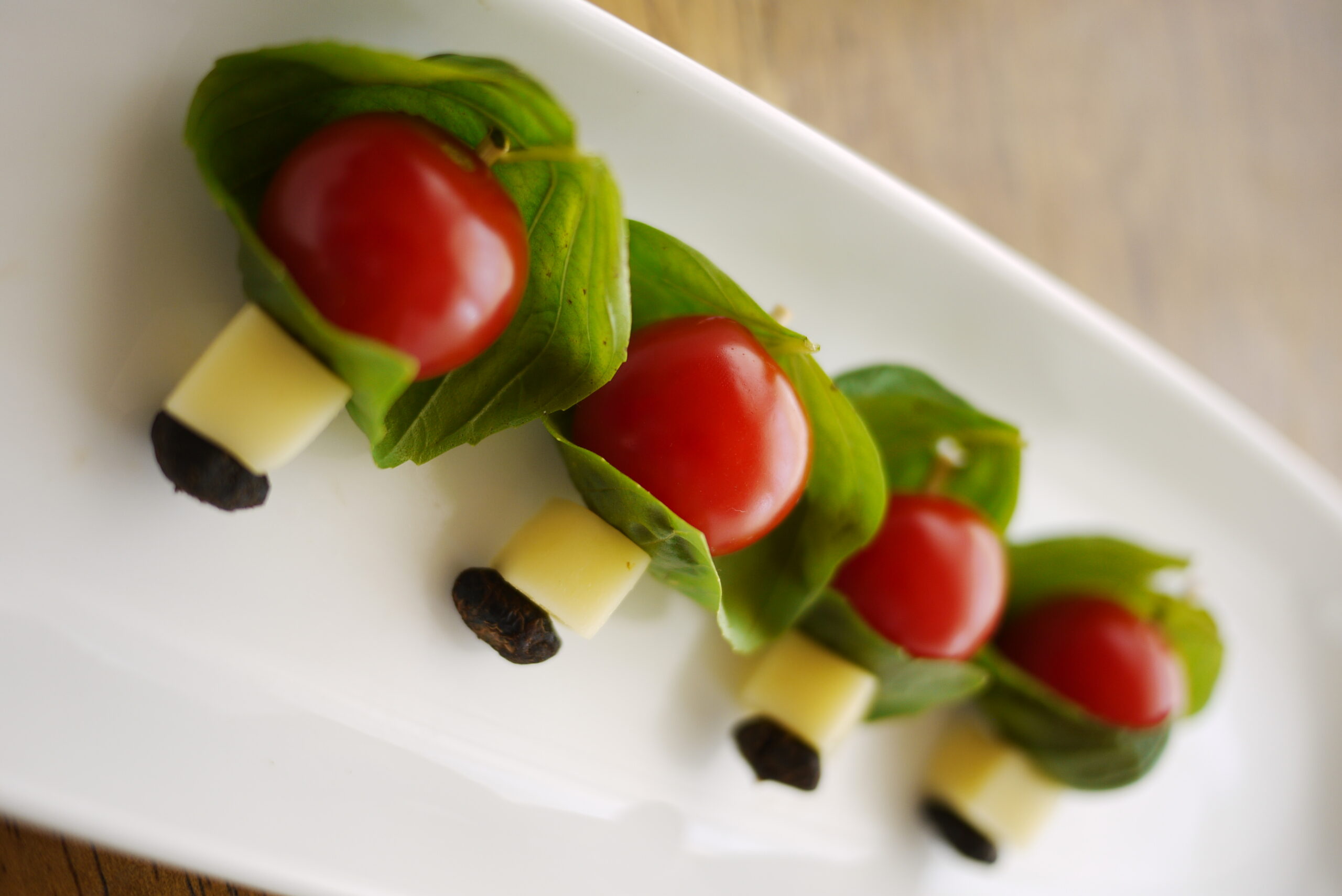
Possible applications include:
- Sauces
- Pasta
- Risotto
- Mushroom dishes
- Roasted vegetables
- Grilled meat
- Tofu
- Rice dishes
- Finishing preparations
The goal does not necessarily have to be making a dish taste strongly of Hamanatto.
The more interesting approach can be to use a small amount to deepen the existing flavors of the dish.
My Take: Why the Flavor Feels So Deep
When I taste Hamanatto, the most interesting characteristic is not simply its saltiness.
It is the way the flavor develops.
The first impression is savory and salty.
Then the fermented character becomes more noticeable.
As the bean is chewed, its firm texture changes the way the flavor is experienced.
That combination of texture, fermentation, salt, aroma, and umami is what makes Hamanatto different from ordinary natto or a simple soy seasoning.
This is also why I think Hamanatto deserves to be understood as an ingredient in its own right.
It is a food where the effects of fermentation remain visible in the bean itself.
Chef’s Verdict
Hamanatto’s deep umami is not the result of one mysterious ingredient.
It is the result of a long fermentation process.
Soybean proteins provide the raw material.
Microorganisms provide enzymes.
Enzymes transform proteins and other components.
Salt changes the fermentation environment and contributes directly to taste.
Drying concentrates the product.
And aging allows further chemical and microbial changes to take place.
The result is a small fermented soybean with a remarkably dense combination of savory taste, saltiness, aroma, and texture.
That is what makes Hamanatto so interesting.
It is not simply “strong umami.”
It is fermentation transformed into a seasoning.
Try Authentic Hamanatto
If you want to understand Hamanatto’s flavor for yourself, start with a small amount alongside something simple.
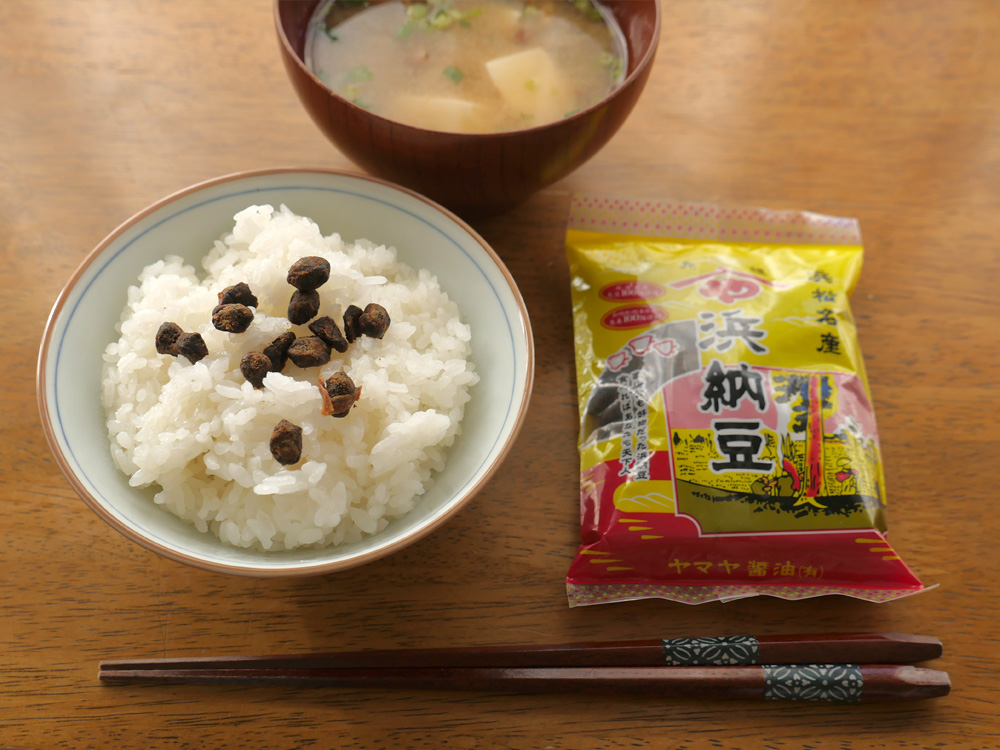
Steamed rice and chilled tofu are good places to begin because their relatively mild flavors allow the fermented character of Hamanatto to stand out.
You can then experiment with sauces, mushrooms, pasta, vegetables, or grilled foods.
Because Hamanatto is concentrated and salty, it is usually better to start with a small amount and adjust gradually.
The goal is not necessarily to make the entire dish taste like Hamanatto.
Instead, try to discover the point at which it adds depth without overpowering the other ingredients.
CTA: Discover Authentic Hamanatto
Continue Reading
If you are interested in Hamanatto, Japanese fermentation, and the science of umami, continue with these articles:
- What Is Hamanatto? Japan’s Hidden Fermented Soybean Treasure
- The History of Hamanatto: From Temple Fermentation to Modern Japanese Cuisine
- What Does Hamanatto Taste Like? A Complete Tasting Guide
- How to Use Hamanatto: Traditional and Modern Applications
- Hamanatto vs. Natto: What’s the Difference?
- Hamanatto vs. Miso: What’s the Difference?
- Why Fermentation Creates Umami
- What Is Umami? The Fifth Taste That Changed Modern Cuisine
Final Thoughts
Hamanatto is a fascinating example of how fermentation can transform a familiar ingredient.
The soybean that enters the process is not the same food that eventually reaches the table.
Its proteins have been transformed.
Its moisture has changed.
Its aroma has developed.
Its texture has become firmer.
And its flavor has become concentrated.
The science behind Hamanatto is therefore not about one magic molecule.
It is about the interaction between microorganisms, enzymes, proteins, amino acids, salt, water, time, and traditional food-making techniques.
That combination is what gives Hamanatto its distinctive character.
The next time you taste one of these small fermented beans, you are tasting much more than soybean.
You are tasting the result of a long biochemical process.
References
Umami Information Center — Miso
Used for the explanation of soybean protein breakdown, free amino acids, glutamate, and the relationship between fermentation conditions and umami.

Kondo & Ito — Microbiological Studies on Hamanatto
Used for information concerning microorganisms associated with Hamanatto, including Aspergillus oryzae-type filamentous fungi and their enzyme activities.

Journal of the Brewing Society, Japan — Research on Hamanatto Production
Used for information concerning traditional Hamanatto production, including processing, fermentation, drying, salting, and aging.

Research on Bacillus subtilis natto
Used only to explain the biological distinction between ordinary sticky natto and Hamanatto.

Research on Fermented Soybean Aroma and Post-Ripening
Used as broader scientific context for changes in volatile compounds during fermentation and post-ripening. These findings are not presented as direct chemical measurements of Hamanatto.