
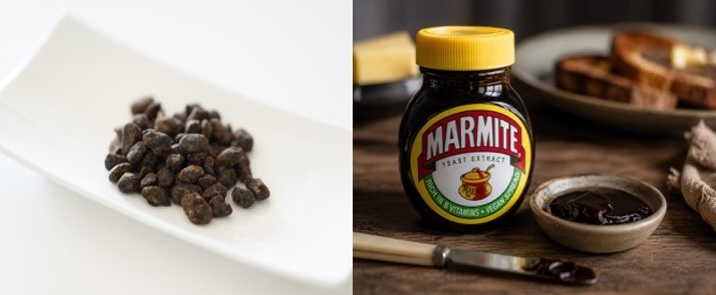
Hamanatto vs Marmite
What’s the Difference?
Hamanatto vs Marmite
When people talk about foods with powerful umami, Marmite is often one of the first names that comes to mind.
Its bold, savory flavor has divided opinions for more than a century.
Some people love it.
Others cannot eat it at all.
Hamanatto creates a similar reaction—not because it tastes the same, but because it delivers an equally memorable umami experience.
Although these two foods come from opposite sides of the world, they share one important characteristic:
Both transform humble ingredients into intensely flavorful foods through fermentation.
Beyond that similarity, however, they are completely different.
Their ingredients, production methods, textures, and culinary roles have little in common.
Understanding these differences helps explain why chefs use them in entirely different ways.
Quick Comparison
| Feature | Hamanatto | Marmite |
|---|---|---|
| Country of Origin | Japan | United Kingdom |
| Main Ingredient | Whole soybeans | Brewer’s yeast extract |
| Form | Whole fermented soybeans | Thick spread |
| Texture | Firm and chewy | Smooth paste |
| Main Use | Finishing ingredient & Cooking seasoning | Bread spread and seasoning |
| Flavor | Deep, mature umami | Salty, intensely savory |
What Is Marmite?
Marmite is a concentrated yeast extract first developed in the United Kingdom in the early twentieth century.
It is produced using spent brewer’s yeast, which is carefully processed into a thick, dark paste.
Only a small amount is needed because its flavor is extremely concentrated.
Many people enjoy Marmite on:
- Buttered toast
- Sandwiches
- Crackers
- Soups
- Stews
Some chefs also use small quantities to increase the savory depth of sauces and braised dishes.
Its famous slogan, “Love it or hate it,” reflects just how distinctive its flavor is.
What Is Hamanatto?
Hamanatto is one of Japan’s oldest fermented soybean foods.
Unlike Marmite, it is made from whole soybeans that are fermented with koji mold before being aged for more than one year.
Throughout this slow process, moisture gradually decreases while natural umami becomes increasingly concentrated.
The finished beans remain:
- Firm
- Dry
- Chewy
- Intensely savory
Rather than being spread on bread, Hamanatto is usually served in small quantities as a premium finishing ingredient or cooking seasoning.
Its unique texture makes it as visually appealing as it is flavorful.
Why Are They Often Compared?
At first glance, Hamanatto and Marmite seem unrelated.
One comes from Japan.
The other comes from Britain.
One is made from soybeans.
The other is made from yeast.
Yet they are frequently compared because both are celebrated for delivering extraordinary umami.
Food enthusiasts searching for naturally savory ingredients often encounter both products.
Professional chefs appreciate them for a similar reason:
A very small amount can dramatically increase the complexity of a dish.
That shared ability to enhance flavor makes them interesting to compare, even though they belong to completely different culinary traditions.
Discover Authentic Japanese Umami
Both Hamanatto and Marmite demonstrate the remarkable power of fermentation.
Experience authentic Hamanatto and discover how more than a year of traditional aging creates one of Japan’s deepest natural sources of umami.
Texture: Whole Beans vs Smooth Spread
The first difference becomes obvious the moment you see them.
Hamanatto consists of whole fermented soybeans.
Each bean remains firm after more than a year of aging, creating a satisfying bite that slowly releases layers of umami.
Its texture is an important part of the experience.
Marmite is completely different.
It is a thick, smooth spread with no visible pieces.
Because it dissolves easily, it spreads evenly across bread or blends naturally into soups and sauces.
For chefs, this distinction is significant.
Hamanatto contributes both texture and flavor.
Marmite contributes flavor alone.
Flavor: Complex vs Intense
Both foods are famous for their powerful umami.
However, the character of that umami is remarkably different.
Hamanatto develops a mature, layered flavor through slow fermentation and long aging.
People often compare it to:
- Aged Parmesan cheese
- Dry-cured olives
- Long-aged soy sauce
- Fermented black beans
Its flavor unfolds gradually as you chew.
Marmite delivers immediate intensity.
Its concentrated yeast extract creates a bold combination of:
- Saltiness
- Savory richness
- Slight bitterness
- Toasted notes
Even a very small amount has a dramatic impact.
Rather than replacing one another, the two ingredients offer entirely different expressions of umami.
Aroma: Mature vs Yeasty
The aromas also reflect their different origins.
Hamanatto develops a refined fragrance during its long aging period.
You may notice hints of:
- Roasted soybeans
- Toasted nuts
- Cocoa
- Dark miso
- Aged cheese
Its aroma continues to evolve as the beans warm on the plate.
Marmite has a distinctive yeast aroma.
Its scent is rich, roasted, and unmistakably savory.
Many people recognize it instantly before tasting it.
While Hamanatto emphasizes elegance, Marmite emphasizes intensity.
Fermentation Process
Although both rely on fermentation, they begin with completely different ingredients.
| Hamanatto | Marmite |
|---|---|
| Whole soybeans | Brewer’s yeast extract |
| Koji mold fermentation | Yeast processing after brewing |
| Aged for about one year or longer | Produced through yeast extraction and concentration |
| Whole finished product | Thick spread |
This difference explains why their flavors share similarities in umami while remaining completely unique.
How Professional Chefs Use Them
Modern chefs use both ingredients carefully because of their concentrated flavors.
Marmite is commonly used for:
- Broths
- Gravies
- Meat sauces
- Stews
- Compound butter
Its purpose is usually to deepen the background flavor.
Hamanatto is often used for:
- Pasta
- Risotto
- Steak
- Seafood
- Cheese
- Roasted vegetables
- Fine dining garnishes
Instead of disappearing into the dish, Hamanatto remains visible, giving diners both texture and bursts of natural umami.
Some chefs even combine the two in experimental cuisine, using Marmite to enrich the base of a sauce while finishing the plate with Hamanatto.
Discover Authentic Japanese Umami
Marmite and Hamanatto both demonstrate the extraordinary power of fermentation.
Experience authentic Hamanatto and discover why its firm texture and naturally aged umami create a flavor unlike any yeast spread.
Can Hamanatto Replace Marmite?
The simple answer is no.
Although both ingredients are celebrated for their umami, they play very different roles in the kitchen.
Marmite is a spread and concentrated seasoning.
It dissolves easily into soups, sauces, gravies, and stews, enriching the overall flavor without adding texture.
Hamanatto is an ingredient.
Its firm, whole soybeans remain visible and provide both texture and concentrated umami.
Replacing Marmite with Hamanatto—or Hamanatto with Marmite—would completely change the character of a dish.
Rather than replacing one another, they offer two different approaches to building savory depth.
Which One Should You Choose?

The best choice depends on the type of cooking you enjoy.
Choose Marmite if you need:
- A concentrated savory spread
- A seasoning for soups and sauces
- A quick source of umami
- An ingredient for Western comfort food
Choose Hamanatto if you want:
- A premium finishing ingredient
- Firm texture as well as flavor
- Naturally aged umami
- A rare Japanese specialty
- A sophisticated garnish for fine dining
Professional chefs often value Hamanatto because it contributes something Marmite cannot—an elegant textural element alongside its umami.
Frequently Asked Questions
Is Hamanatto similar to Marmite?
Only in one respect.
Both are naturally rich in umami.
However, they are made from completely different ingredients and have entirely different textures, flavors, and culinary uses.
Which one tastes stronger?
Marmite delivers an immediate burst of salty, yeast-based flavor.
Hamanatto develops its umami more gradually, creating a deeper and more layered tasting experience.
Can I spread Hamanatto on toast?
Not in the same way as Marmite.
Hamanatto is not a paste.
However, finely chopped Hamanatto mixed with butter can create an excellent spread for artisan bread.
Why do chefs use Hamanatto instead of Marmite?
Chefs often choose Hamanatto when they want visible texture as well as concentrated umami.
Its whole beans provide both visual appeal and a memorable eating experience.
Is Hamanatto rarer than Marmite?
Yes.
Marmite is produced on a large commercial scale and sold worldwide.
Authentic Hamanatto is handcrafted by only a handful of traditional producers in Japan, making it one of the country’s rarest fermented foods.
Chef’s Verdict
For chefs, the comparison between Hamanatto and Marmite is not about choosing a winner.
It is about understanding their strengths.
Marmite is excellent for enriching the background flavor of a dish.
Hamanatto excels at delivering concentrated umami while preserving texture and visual elegance.
That combination makes Hamanatto particularly valuable in modern fine dining, where every ingredient is expected to contribute both flavor and presentation.
Rather than replacing Marmite, Hamanatto expands the chef’s creative possibilities.
Final Thoughts
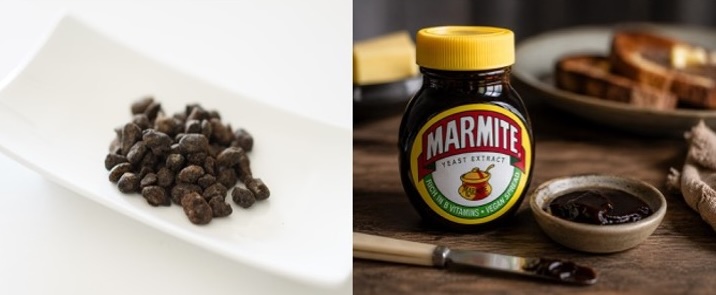
Hamanatto and Marmite demonstrate that fermentation can produce extraordinary umami from completely different ingredients.
One is born from soybeans.
The other comes from brewer’s yeast.
Yet both have earned loyal followings because they transform simple ingredients into unforgettable flavors.
For food lovers, tasting both reveals how different fermentation traditions can arrive at the same goal: creating deeper, richer, and more satisfying cuisine.
For chefs, they represent two distinct tools—each capable of adding remarkable complexity when used with care.
Related Articles
Continue exploring Japanese fermentation:
- What Is Hamanatto?
- How Hamanatto Is Made
- What Hamanatto Tastes Like
- Why Hamanatto Is a Natural Umami Bomb
- Hamanatto vs Natto
- Hamanatto vs Miso
- Hamanatto vs Soy Sauce
- Hamanatto vs Douchi
- Why Michelin Chefs Should Know Hamanatto
Discover Authentic Hamanatto
Marmite introduced the world to the power of concentrated umami.
Authentic Hamanatto offers a different experience—firm, naturally aged, and handcrafted using traditional Japanese methods for more than a year.
Discover one of Japan’s rarest fermented delicacies and experience umami in its purest form.