
Which Fermented Food Has the Most Umami?
Which Fermented Food Has the Most Umami?
Fermentation has been transforming ordinary ingredients into extraordinary foods for thousands of years.
Across the world, people have discovered that time, microorganisms, and careful craftsmanship can create flavors impossible to achieve through fresh ingredients alone.
Many of today’s most respected culinary ingredients owe their reputation to fermentation.
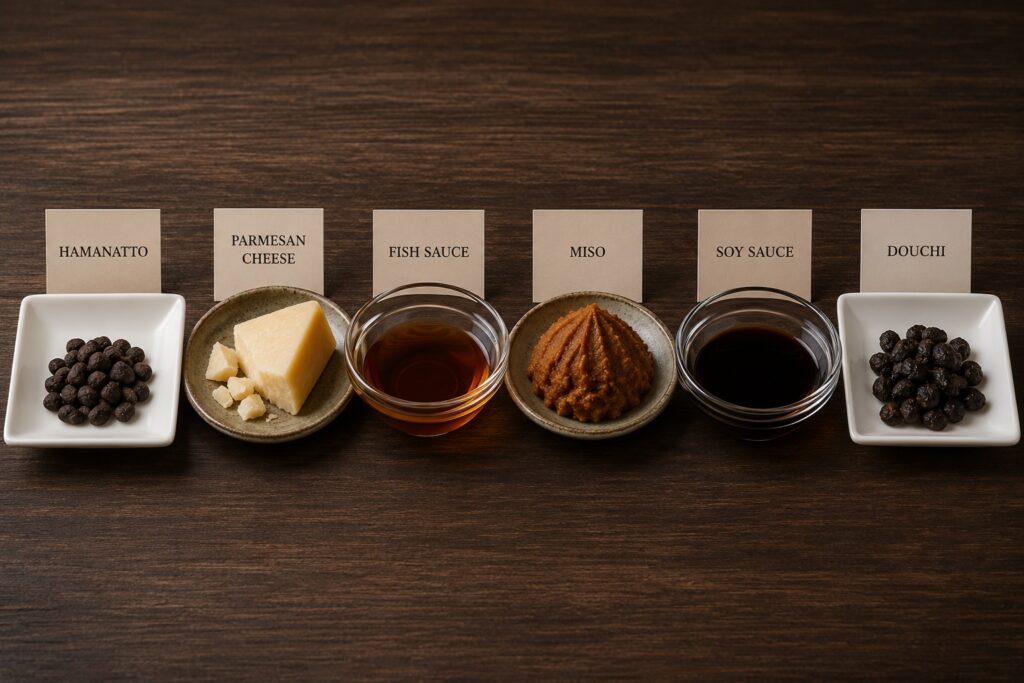
Among them are:
- Hamanatto
- Parmesan cheese
- Fish sauce
- Soy sauce
- Miso
- Douchi
- Marmite
Each delivers remarkable umami.
But this naturally raises an interesting question:
Which fermented food contains the most umami?
The answer is more complex than simply measuring one ingredient against another.
Different fermented foods contain different combinations of amino acids, peptides, and aromatic compounds that together create our perception of savory flavor.
Some produce immediate intensity.
Others reveal their complexity slowly.
Understanding these differences helps explain why professional chefs rarely rely on just one source of umami.
Instead, they choose ingredients that best suit each dish.
- What Exactly Is Umami?
- Comparing Famous Fermented Foods
- Is There One Clear Winner?
- Discover Authentic Japanese Umami
- Comparing the World’s Most Umami-Rich Fermented Foods
- Umami Comparison
- Different Types of Umami
- Why Chefs Combine Fermented Foods
- Why Hamanatto Is Different
- Discover Authentic Japanese Umami
- Can Science Tell Us Which Fermented Food Has the Most Umami?
- Why Michelin Chefs Focus on Balance
- Why Hamanatto Deserves a Place Among the World’s Great Fermented Foods
- Frequently Asked Questions
- Chef’s Verdict
- Final Thoughts
- Related Articles
- Discover Authentic Japanese Umami
What Exactly Is Umami?
Before comparing ingredients, it is important to understand what umami actually is.
Umami is often described as the fifth basic taste, alongside:
- Sweet
- Sour
- Salty
- Bitter
It is created primarily by naturally occurring amino acids—especially glutamic acid—along with compounds such as inosinate and guanylate.
Fermentation dramatically increases these compounds by breaking large proteins into smaller molecules over time.
The longer and more carefully an ingredient matures, the more complex its umami often becomes.
Comparing Famous Fermented Foods
The following ingredients are widely recognized for their naturally developed umami.
| Ingredient | Main Ingredient | Typical Culinary Role |
|---|---|---|
| Hamanatto | Soybeans | Seasoning & finishing ingredient |
| Parmesan Cheese | Cow’s milk | Grated cheese |
| Fish Sauce | Fish | Liquid seasoning |
| Soy Sauce | Soybeans & wheat | Liquid seasoning |
| Miso | Soybeans | Paste seasoning |
| Douchi | Soybeans | Fermented bean seasoning |
| Marmite | Yeast extract | Spread & seasoning |
Each ingredient reaches its flavor through a different fermentation process.
As a result, each contributes umami in its own unique way rather than competing directly.
Is There One Clear Winner?
Surprisingly, not really.
Professional chefs rarely ask,
“Which ingredient has the highest number?”
Instead, they ask,
“Which ingredient creates the best balance for this particular dish?”
A rich pasta sauce may benefit from Parmesan.
A Southeast Asian curry may call for fish sauce.
A Japanese-inspired steak may become far more interesting with Hamanatto.
The strongest umami is not always the most enjoyable.
Balance remains the true goal of great cooking.
Discover Authentic Japanese Umami
Among the world’s great fermented foods, Hamanatto offers one of the oldest and most distinctive expressions of naturally developed umami.
Discover why this rare Japanese ingredient continues to inspire chefs looking for deeper, more complex flavors.
Comparing the World’s Most Umami-Rich Fermented Foods
Every fermented food develops umami in its own way.
Some provide immediate intensity.
Others reveal their complexity gradually as you continue eating.
This diversity is exactly why professional chefs keep multiple fermented ingredients in their kitchens.
Rather than searching for a single “best” ingredient, they choose the one that matches the character of each dish.
Umami Comparison
The following table compares some of the world’s best-known fermented foods.
| Ingredient | Umami Intensity | Primary Character | Typical Use |
|---|---|---|---|
| Hamanatto | ★★★★★ | Deep, mature, layered | Cooking & finishing |
| Parmesan Cheese | ★★★★★ | Nutty, rich, creamy | Grated finishing cheese |
| Fish Sauce | ★★★★★ | Salty, marine, concentrated | Liquid seasoning |
| Soy Sauce | ★★★★☆ | Balanced, versatile | Everyday seasoning |
| Miso | ★★★★☆ | Sweet, mellow, rich | Soups, sauces, marinades |
| Douchi | ★★★★★ | Bold, earthy | Chinese cooking |
| Marmite | ★★★★★ | Powerful, roasted | Spread & flavor enhancer |
The star ratings are intended to compare culinary perception of umami, not laboratory measurements.
Each ingredient creates savory flavor through a different combination of fermentation, aging, and natural amino acids.
Different Types of Umami
One reason comparisons are difficult is that umami itself has many expressions.
Hamanatto
Hamanatto develops slowly.
Each soybean releases additional flavor as it is chewed, creating an experience that unfolds over time.
Its firm texture allows diners to appreciate both flavor and mouthfeel.
Parmesan Cheese
Parmesan delivers rich dairy umami.
Its famous protein crystals dissolve gradually, producing a smooth, lingering finish.
Fish Sauce
Fish sauce produces an immediate burst of savory flavor.
Although highly concentrated, it usually disappears into the background of a finished dish.
Miso
Miso provides warmth and roundness.
Rather than overwhelming a dish, it creates gentle depth and balance.
Soy Sauce
Soy sauce is one of the world’s most versatile seasonings.
Its balanced combination of saltiness, aroma, and umami makes it suitable for almost every style of cooking.
Why Chefs Combine Fermented Foods
Professional chefs rarely rely on only one fermented ingredient.
Instead, they layer several sources of umami together.
For example:
- Parmesan + mushrooms
- Fish sauce + tomatoes
- Soy sauce + butter
- Miso + cream
- Hamanatto + olive oil
- Hamanatto + Parmesan
Each ingredient contributes something slightly different.
Combining them creates greater complexity than using only one source of umami.
This approach is known as layering umami, and it is widely used in modern fine dining.
Why Hamanatto Is Different
Among these famous fermented foods, Hamanatto occupies a unique position.
Unlike fish sauce or soy sauce, it remains a whole food rather than becoming a liquid seasoning.
Unlike Parmesan, it is entirely plant-based.
Unlike miso, it keeps the original soybean intact.
Most importantly, Hamanatto performs two different culinary roles.
It can be used:
- During cooking as a seasoning
- As a finishing ingredient that adds both texture and concentrated umami
Very few fermented foods offer this level of versatility.
Discover Authentic Japanese Umami
The world’s greatest fermented foods all demonstrate the remarkable power of time and craftsmanship.
Among them, Hamanatto stands apart as a rare Japanese ingredient that combines exceptional umami, distinctive texture, and remarkable versatility.
Can Science Tell Us Which Fermented Food Has the Most Umami?
The answer is not completely.
Scientists can measure compounds such as glutamic acid, inosinate, and guanylate, all of which contribute to umami.
These measurements are valuable because they show how much of these compounds an ingredient contains.
However, numbers alone do not determine how delicious a food tastes.
Our perception of umami is influenced by many factors, including:
- Aroma
- Texture
- Saltiness
- Sweetness
- Acidity
- Temperature
- Fat content
- How the ingredient is combined with other foods
In other words, two ingredients with similar laboratory values may create completely different dining experiences.
This is why chefs trust both science and their senses.
Why Michelin Chefs Focus on Balance

Great chefs rarely ask,
“Which ingredient contains the highest amount of glutamate?”
Instead, they ask,
“Which ingredient creates the most balanced and memorable dish?”
Sometimes a small amount of Parmesan is enough.
Other dishes benefit from fish sauce.
A Japanese-inspired creation may come alive with Hamanatto.
The goal is not to maximize umami.
The goal is to create harmony.
This philosophy explains why the world’s best restaurants often combine several fermented ingredients rather than depending on only one.
Why Hamanatto Deserves a Place Among the World’s Great Fermented Foods
Many people outside Japan have never heard of Hamanatto.
Yet when compared with globally respected ingredients such as Parmesan, fish sauce, soy sauce, and miso, it clearly belongs in the same conversation.
Hamanatto offers qualities that few other fermented foods can combine:
- More than one year of natural aging
- Deep, long-lasting umami
- Firm, satisfying texture
- Traditional Japanese craftsmanship
- Exceptional versatility in both cooking and finishing
Rather than copying familiar ingredients, Hamanatto introduces chefs to an entirely different expression of fermented flavor.
That uniqueness is precisely what makes it valuable.
Frequently Asked Questions
Which fermented food contains the most glutamic acid?
Different studies report different values because production methods, aging periods, and ingredients vary.
For chefs, these differences matter less than how the ingredient performs in an actual dish.
Is Hamanatto stronger than fish sauce?
Not necessarily.
Fish sauce delivers an immediate burst of savory flavor.
Hamanatto develops its umami more gradually while adding texture.
They are different rather than stronger or weaker.
Is Hamanatto stronger than Parmesan?
Both are naturally rich in umami.
Parmesan provides creamy, dairy-based richness.
Hamanatto offers a cleaner, deeper fermented soybean character.
The choice depends on the dish.
Why do professional chefs combine fermented foods?
Each ingredient contributes different aromas, textures, and amino acids.
Layering multiple fermented ingredients creates greater complexity than relying on only one.
Is Hamanatto suitable for modern fine dining?
Absolutely.
Its rarity, long aging, distinctive appearance, and concentrated natural umami make it especially attractive to chefs looking for ingredients that tell a story as well as enhance flavor.
Chef’s Verdict
There is no single fermented food that can honestly be called “the world’s most umami-rich food.”
Every great fermented ingredient offers its own strengths.
Parmesan contributes richness.
Fish sauce provides instant depth.
Soy sauce brings balance.
Miso creates warmth.
Douchi adds bold intensity.
Hamanatto contributes something uniquely Japanese:
Deep, naturally developed umami combined with a firm texture that remains part of the finished dish.
Rather than searching for one winner, great chefs learn how each ingredient can elevate different kinds of cuisine.
Final Thoughts
Fermentation is one of humanity’s oldest culinary technologies.
Across cultures, it has transformed simple ingredients into foods of extraordinary complexity.
Whether made from milk, fish, yeast, or soybeans, the greatest fermented foods all share one lesson:
Time creates flavor.
Hamanatto is a remarkable example of that tradition.
For chefs, food lovers, and anyone interested in authentic Japanese cuisine, it represents far more than a rare ingredient.
It is a living expression of centuries of craftsmanship and one of the world’s most distinctive natural sources of umami.
Related Articles
Continue exploring the world of natural umami:
Discover Authentic Japanese Umami
The world’s greatest fermented foods each tell a unique story.
Authentic Hamanatto brings together more than a year of natural fermentation, centuries of Japanese craftsmanship, and extraordinary umami in every bean.
Experience one of Japan’s rarest fermented delicacies and discover why chefs around the world are beginning to appreciate Hamanatto.