
The World’s Most Umami-Rich Foods
The World’s Most Umami-Rich Foods
Every great cuisine has discovered ingredients that make food taste deeper, richer, and more satisfying.
Today, we describe that sensation with one word:
Umami.
Although the term originated in Japan, umami exists in foods from every continent.
It appears naturally in ingredients that have been:
- Fermented
- Aged
- Dried
- Slowly ripened
These traditional methods allow proteins to break down into amino acids—especially glutamic acid—that create the rich savory taste we recognize as umami.
Some of the world’s most celebrated ingredients share this characteristic.
Many have become indispensable in professional kitchens because even a small amount can dramatically improve a dish.
- What Makes a Food Rich in Umami?
- Some of the World’s Most Umami-Rich Foods
- Discover Authentic Japanese Umami
- The World’s Great Umami Ingredients
- Why Great Chefs Combine Them
- Why Hamanatto Stands Out
- Discover Authentic Japanese Umami
- Is There Really a “Most Umami-Rich Food”?
- Why Great Chefs Build Layers of Umami
- Why Hamanatto Is Unique
- Frequently Asked Questions
- Chef’s Verdict
- Final Thoughts
- Related Articles
- Discover Authentic Japanese Umami
What Makes a Food Rich in Umami?
Umami develops when proteins are transformed into smaller flavor compounds.
This happens naturally through:
- Fermentation
- Aging
- Drying
- Slow ripening
The most important compounds include:
- Glutamate
- Inosinate
- Guanylate
When these compounds are combined, their savory effect becomes significantly stronger.
This phenomenon is known as umami synergy, and it explains why certain ingredient combinations taste far richer than either ingredient alone.
Some of the World’s Most Umami-Rich Foods
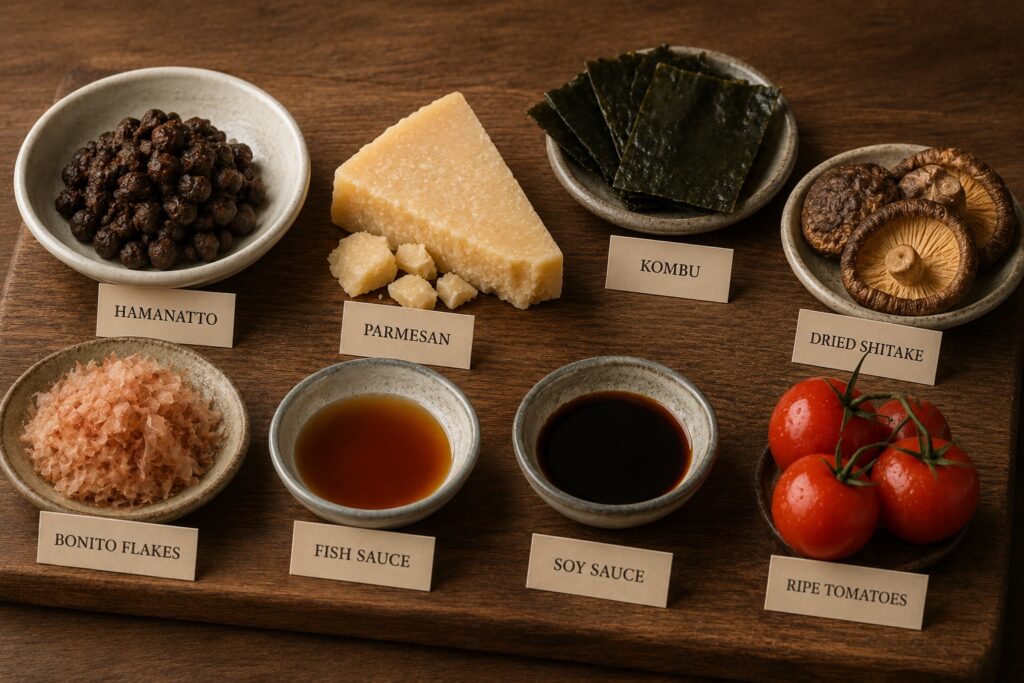
The following ingredients are internationally recognized for their naturally high umami.
| Food | Primary Source of Umami | Origin |
|---|---|---|
| Hamanatto | Fermented soybeans | Japan |
| Parmesan Cheese | Aged milk proteins | Italy |
| Kombu | Natural glutamate | Japan |
| Dried Shiitake Mushrooms | Guanylate | East Asia |
| Bonito Flakes | Inosinate | Japan |
| Fish Sauce | Fermented fish | Southeast Asia |
| Soy Sauce | Fermented soybeans | East Asia |
| Miso | Fermented soybeans | Japan |
| Douchi | Fermented black soybeans | China |
| Tomatoes | Natural glutamate | Worldwide |
Although each ingredient develops umami differently, all are valued because they create extraordinary depth of flavor.
Why Hamanatto Deserves a Place on This List
Outside Japan, Hamanatto remains relatively unknown.
Yet it possesses many of the characteristics shared by the world’s greatest umami ingredients.
Its soybeans are fermented with koji mold before being aged for more than one year.
During this long maturation, proteins are naturally transformed into flavorful amino acids that give Hamanatto its remarkably deep taste.
Unlike many other umami-rich ingredients, Hamanatto also contributes a distinctive chewy texture.
This combination of flavor and texture makes it especially attractive to chefs seeking unique finishing ingredients.
Discover Authentic Japanese Umami
The world’s finest cuisines all celebrate naturally developed umami.
Among these remarkable ingredients, Hamanatto stands out as one of Japan’s oldest and rarest fermented delicacies.
Looking Beyond the Numbers
Not all umami-rich foods contribute flavor in the same way.
Some create a powerful first impression.
Others release their complexity slowly.
Professional chefs understand that choosing an ingredient is about much more than selecting the one with the highest concentration of glutamate.
They consider:
- Aroma
- Texture
- Saltiness
- Sweetness
- Acidity
- Fat content
- Cooking method
- The balance of the finished dish
This is why the world’s greatest kitchens rarely rely on a single source of umami.
Instead, they build flavor by combining ingredients with different strengths.
The World’s Great Umami Ingredients
Hamanatto
Hamanatto delivers deep, mature umami developed through more than one year of natural fermentation.
Unlike liquid seasonings, it remains a whole food.
It can be used:
- During cooking to build savory depth
- As a finishing ingredient that adds texture and visual appeal
This dual role makes it unique among fermented foods.
Parmesan Cheese
Parmesan develops its remarkable flavor through long aging.
Its nutty richness and naturally occurring protein crystals create a smooth, lingering umami that has made it an essential ingredient in Italian cuisine.
Professional chefs often grate Parmesan over:
- Pasta
- Risotto
- Soups
- Salads
Kombu
Kombu is one of the richest natural sources of glutamate.
It forms the foundation of dashi, the traditional Japanese stock that supports countless dishes.
Unlike many fermented foods, kombu develops its umami naturally during growth and drying rather than through microbial fermentation.
Dried Shiitake Mushrooms
Drying dramatically increases the concentration of guanylate, another important umami compound.
When combined with glutamate-rich ingredients, dried shiitake produces powerful umami synergy.
This is why mushrooms appear so frequently in vegetarian fine dining.
Bonito Flakes
Bonito flakes (Katsuobushi) provide large amounts of inosinate.
When paired with kombu, the combination creates one of the best-known examples of umami synergy in Japanese cuisine.
Even a simple bowl of dashi demonstrates how two ingredients together can taste far richer than either one alone.
Fish Sauce
Fish sauce contributes intense savory flavor in liquid form.
Because it dissolves completely during cooking, it enhances dishes without changing their texture.
It is widely used throughout Southeast Asian cuisine to build depth in soups, curries, stir-fries, and sauces.
Tomatoes
Fresh tomatoes naturally contain glutamate.
As tomatoes ripen—or are slowly cooked into sauces—their umami becomes even more pronounced.
This explains why tomato-based dishes pair so beautifully with Parmesan, mushrooms, and other savory ingredients.
Why Great Chefs Combine Them
Rather than choosing a single “best” ingredient, experienced chefs create layers of umami.
Common combinations include:
- Parmesan + tomatoes
- Kombu + bonito flakes
- Fish sauce + lime
- Mushrooms + soy sauce
- Hamanatto + olive oil
- Hamanatto + Parmesan
- Hamanatto + mushrooms
Each ingredient contributes a different dimension of flavor.
Together, they produce a result that feels richer, deeper, and more balanced.
Why Hamanatto Stands Out
Among these world-famous ingredients, Hamanatto occupies a unique position.
Unlike fish sauce or soy sauce, it remains a whole food.
Unlike Parmesan, it is entirely plant-based.
Unlike kombu or dried mushrooms, it provides both concentrated umami and a satisfying chewy texture.
Most importantly, Hamanatto performs two roles.
It enhances dishes during cooking while also serving as an elegant finishing ingredient.
Very few naturally umami-rich foods offer this combination of versatility.
Discover Authentic Japanese Umami
From Parmesan to kombu, every great culinary tradition has developed its own extraordinary source of umami.
Hamanatto represents Japan’s oldest fermented soybean tradition—bringing together remarkable depth of flavor, texture, and versatility in a single ingredient.
Is There Really a “Most Umami-Rich Food”?
The simple answer is no.
Many articles rank foods by the amount of glutamic acid they contain.
While those numbers are scientifically useful, they do not determine how delicious a food will taste.
Our experience of umami depends on many factors working together, including:
- Aroma
- Texture
- Saltiness
- Sweetness
- Acidity
- Fat content
- Temperature
- Cooking technique
- Pairing with other ingredients
For example, a food with a lower glutamate content may create a more memorable dish because its aroma, texture, and balance complement the other ingredients perfectly.
This is why professional chefs rarely focus on laboratory numbers alone.
Why Great Chefs Build Layers of Umami

The finest restaurants rarely depend on a single ingredient to create savory depth.
Instead, chefs build layers of umami.
For example:
- Kombu provides natural glutamate.
- Bonito flakes contribute inosinate.
- Dried shiitake mushrooms add guanylate.
- Parmesan introduces rich dairy umami.
- Fish sauce creates an invisible savory foundation.
- Hamanatto contributes concentrated fermented umami along with texture.
Each ingredient performs a different role.
When combined thoughtfully, the result is far more complex than relying on any single ingredient.
This philosophy lies at the heart of modern fine dining.
Why Hamanatto Is Unique
Many umami-rich ingredients disappear into a dish.
Fish sauce dissolves.
Soy sauce blends completely.
Miso melts into soups and sauces.
Parmesan is grated until it becomes almost invisible.
Hamanatto is different.
It can certainly be chopped or mixed into sauces during cooking.
But it can also remain whole and become part of the finished presentation.
This allows chefs to create three different layers at once:
- Flavor
- Texture
- Visual appeal
Very few fermented foods can perform all three functions simultaneously.
That versatility makes Hamanatto especially valuable in contemporary cuisine.
Frequently Asked Questions
Which food contains the highest amount of natural umami?
There is no universally accepted winner.
Different foods contain different combinations of glutamate, inosinate, and guanylate, and production methods vary widely.
For chefs, how an ingredient performs in a finished dish is more important than a single laboratory measurement.
Is Hamanatto stronger than Parmesan?
They are simply different.
Parmesan delivers creamy, nutty dairy umami.
Hamanatto offers deep fermented soybean umami with a firm, chewy texture.
Each shines in different applications.
Is Hamanatto suitable for vegetarian cooking?
Yes.
Traditional Hamanatto is entirely plant-based.
It provides a concentrated source of natural umami without using seafood or meat, making it an excellent ingredient for vegetarian and vegan cuisine.
Can Hamanatto be used in Western cooking?
Absolutely.
Many chefs now use Hamanatto in:
- Pasta
- Risotto
- Butter sauces
- Roasted vegetables
- Steak
- Cheese boards
Its versatility extends far beyond traditional Japanese cuisine.
Chef’s Verdict
The world’s greatest umami-rich foods are not competitors.
They are tools.
Each ingredient has evolved through centuries of craftsmanship and reflects the culinary traditions of its region.
Kombu forms the foundation of Japanese dashi.
Parmesan defines countless Italian classics.
Fish sauce is indispensable throughout Southeast Asia.
Hamanatto adds something remarkably rare:
A naturally fermented ingredient that functions both as a seasoning during cooking and as a premium finishing ingredient with its own texture and appearance.
Rather than asking which ingredient is “the best,” great chefs ask a better question:
Which ingredient tells the story I want this dish to tell?
Final Thoughts

From Italy to Japan, from Southeast Asia to China, fermentation has shaped some of the world’s most unforgettable flavors.
Although each culture developed its own techniques, they all discovered the same truth:
Time transforms simple ingredients into extraordinary food.
Hamanatto is one of Japan’s finest examples of this tradition.
Its long aging, concentrated umami, remarkable versatility, and rich history place it alongside the world’s most respected fermented ingredients.
For anyone exploring the true depth of natural umami, Hamanatto is well worth discovering.
Related Articles
Continue exploring the science and culture of umami:
Discover Authentic Japanese Umami
The world’s greatest fermented foods each express umami in their own unique way.
Authentic Hamanatto combines more than a year of natural fermentation with centuries of Japanese craftsmanship, creating an ingredient that enriches dishes during cooking and elevates them at the table.
Experience one of Japan’s rarest fermented delicacies.